

Lost in the In-Between
Part 1: Understanding the Liminal Space


You’re not who you were.
But you’re not yet who you’ll become.
You’re suspended between endings and beginnings. Between the old life that no longer fits and the new life that hasn’t formed yet.
This is the liminal space.
The in-between. The void. The wilderness.
And if you’re here right now—after a layoff, a breakup, a death, a diagnosis, a displacement—you’re not lost.
Even if every fibre of your body is telling you otherwise. Trust me, you are not.
You’re in transition.
In our previous article, we briefly explored the liminal space. This is a deeper dive into one of the most overlooked, under-appreciated concepts in psychology.
The Liminal Space (And Why It Matters)
Liminal comes from the Latin limen, meaning “threshold.”
It’s the space between doorways. The hallway between rooms. The moment after you’ve left home but before you’ve arrived at your destination.
William Bridges, in his book Transitions, calls this the Neutral Zone—the psychological no-man’s-land where the old identity has died but the new one hasn’t been born yet.
Carl Jung called it the confrontation with the unconscious—the descent into the underworld where we face what we’ve been avoiding.
James Hollis, in Through the Middle Passage, Through the Dark Wood, and Swamplands of the Soul, describes it as the Swamplands—the place where all our certainties dissolve and we’re forced to reckon with who we really are beneath the masks we’ve worn.
I even heard Chris Williamson recently call it The Lonely Chapter.
Different labels, same meaning.
This space is universal.
It happens:
When you lose a job (Who am I without my title?)
When a relationship ends (Who am I without them?)
When someone dies (Who am I in a world where they don’t exist?)
When you’re displaced from home (Who am I without my roots?)
When everything you believed shatters (Who am I if my worldview was wrong?)
You didn’t choose this.
But you’re here.
And the question is: How do you get through it without getting lost?
What the Liminal Space Feels Like (And Why It’s Dangerous)
Most people don’t understand what’s happening to them in the liminal space. They don’t even realize they’re there.
They think they’re broken. Failing. Going crazy.
They’re not. You’re not.
They’re in the most psychologically dangerous phase of transition.
Phase 1: The Ending (What You Left Behind)
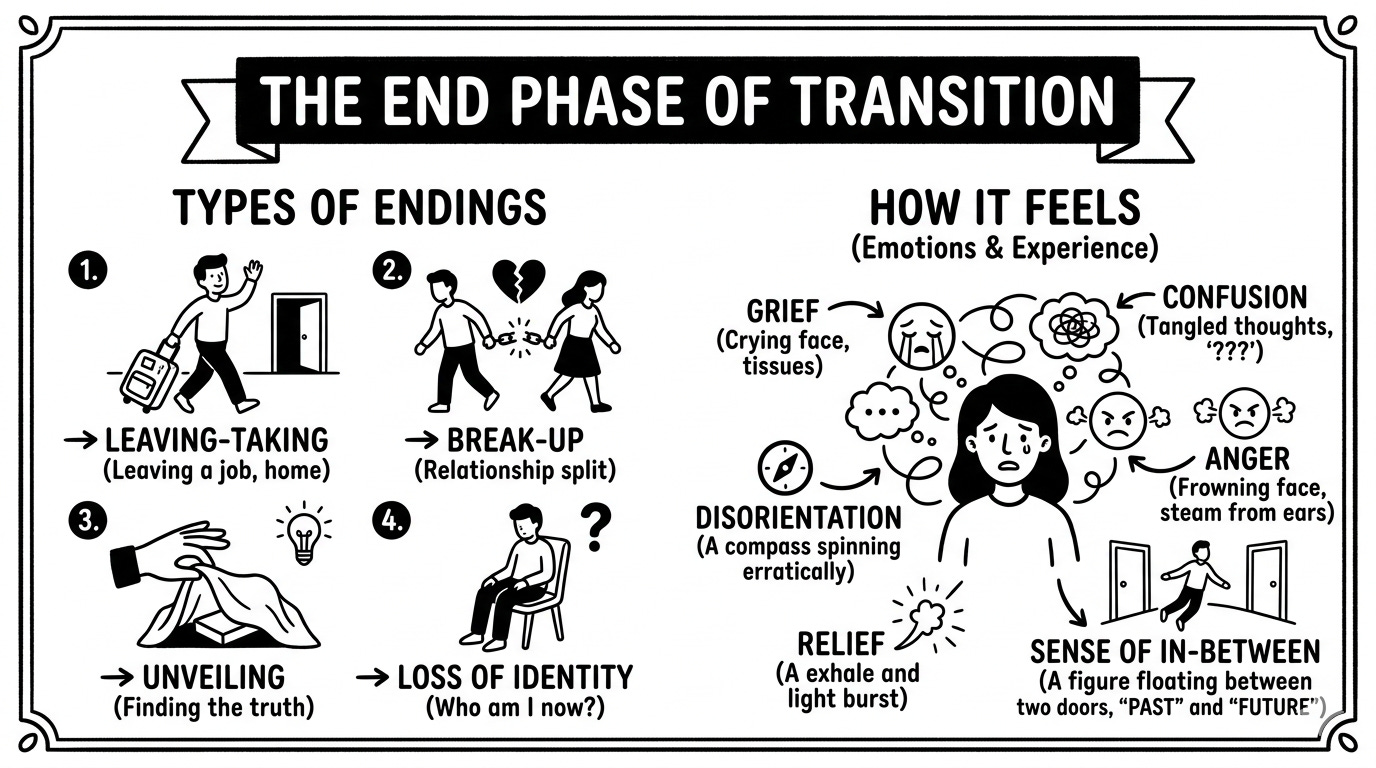
What happened:
Something ended (job, relationship, person, place, identity)
The old life doesn’t fit anymore (or was taken from you)
You’re forced to let go (even if you’re not ready)
What it feels like:
Loss (even if the ending was chosen)
Grief (for who you were, what you had—or hadn’t, maybe)
Anger or numbness (Why me? This isn’t fair. I feel nothing.)
The danger:
Denial (refusing to accept the ending, clinging to the past)
Premature closure (rushing to “move on” without processing, reflecting on, learning from the loss)
Phase 2: The Neutral Zone (Where You Are Now)
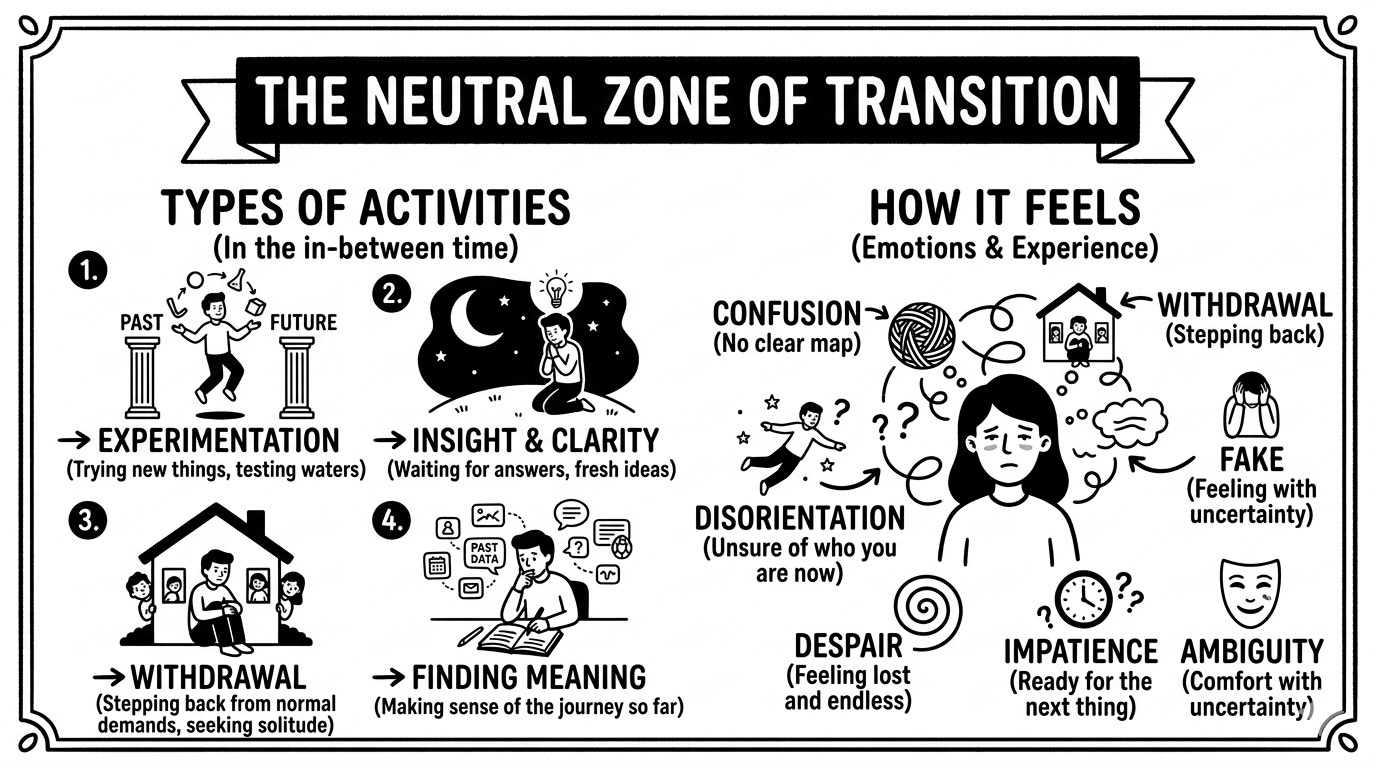
What’s happening:
You’re between identities (not who you were, not yet who you’ll be)
Nothing feels solid (no structure, no clarity, no path forward)
Time feels distorted (days blur, weeks disappear, months drag)
What it feels like:
Emptiness (the old life is gone, the new one hasn’t arrived)
Anxiety (What if I never figure this out? What if I’m stuck forever?)
Confusion (Who am I without the role I played? What do I even want?)
Disorientation (the map you followed no longer works)
Shame (Everyone else has it together. Why don’t I?)
Restlessness (I need to DO something, but I don’t know what)
Loneliness (no one understands what this feels like)
The Loneliness of the Neutral Zone
One of the hardest parts of the Neutral Zone is the loneliness.
Not just physical isolation (though that’s real).
But a deeper kind of alone-ness:
You don’t belong anywhere.
Your old tribe doesn’t understand what you’re going through.
Your old identity doesn’t fit anymore.
And the new tribe, the new identity? They haven’t arrived yet.
Brené Brown calls this braving the wilderness—the place where you’re alone with yourself, without the comfort of belonging to something external.
She writes:
“True belonging doesn’t require you to change who you are; it requires you to be who you are.”
But how do you BE who you are when you don’t even KNOW who you are anymore?
That’s the work of the Neutral Zone.
You’re not waiting for someone to TELL you who you are.
You’re not waiting for a tribe to VALIDATE you.
You’re learning to belong to yourself first.
And that feels like the wilderness.
Uncertain. Unfamiliar. Alone.
But it’s also where you discover:
You don’t need external belonging to feel whole.
You need internal belonging.
The rest comes after.
The danger:
Getting stuck (some people live here for decades—numb, directionless, waiting for someone to rescue them)
Regression (running back to the old life, even if it was toxic, because the unknown is scarier than the familiar)
Premature commitment (grabbing the first job, relationship, identity that appears, just to escape the unsettling sense of void and loneliness)
Self-destruction (numbing with substances, binge eating junk food, unhealthy relationships, overworking, endless scrolling—anything to avoid the discomfort)
This is where people get lost.
Not because they’re weak.
But because no one told them: This is the work.
Phase 3: The New Beginning (What’s Waiting on the Other Side)
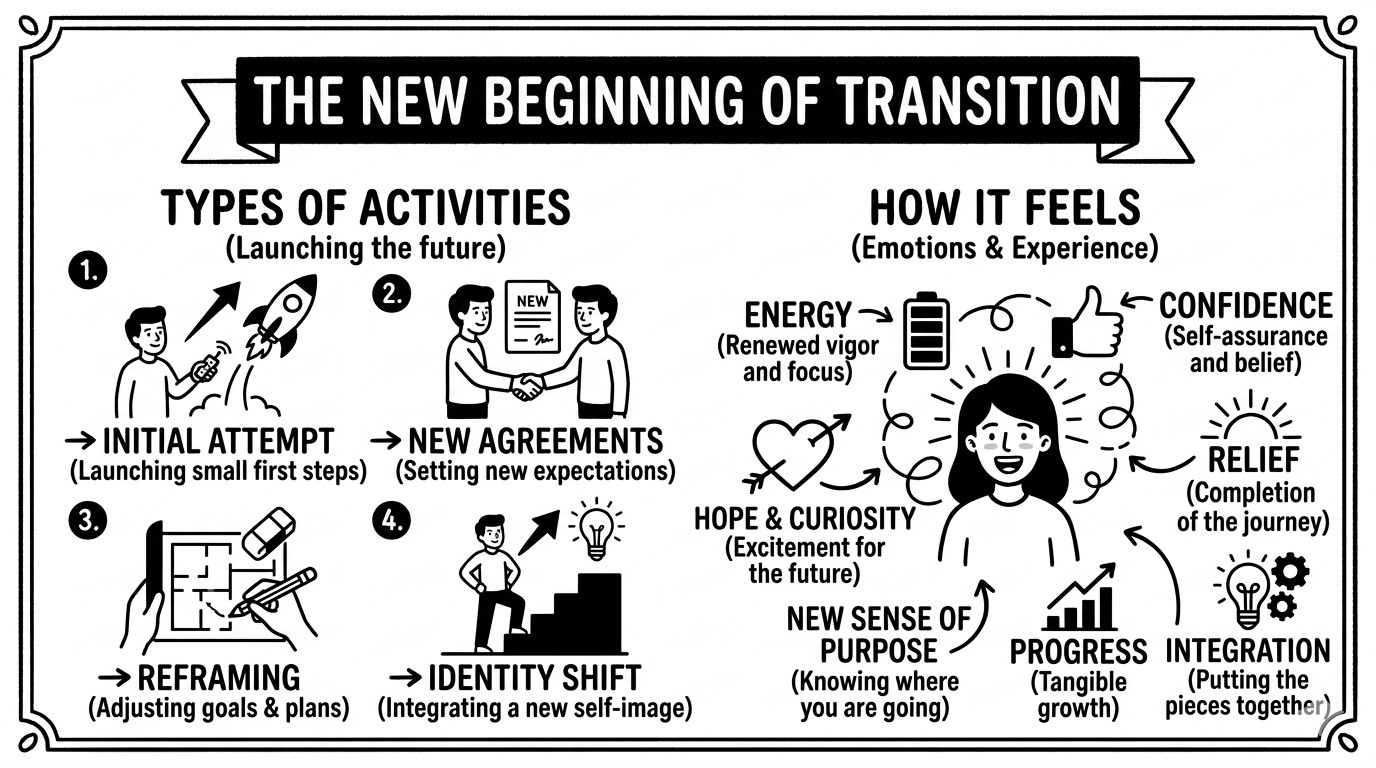
What happens:
Clarity emerges (not all at once, but in glimpses)
A new identity forms (not who you were, but who you’re becoming)
Energy returns (you feel like yourself again—but different)
What it feels like:
Curiosity (What if I tried this? What if I’m capable of more than I thought?)
Hope (Maybe this isn’t the end. Maybe this is a new beginning.)
Integration (the old and new self merge—you carry the past but are no longer defined by it)
Alignment (you’re living closer to who you actually are, not who you thought you should be)
The arrival:
You don’t “arrive” all at once (it’s gradual, subtle)
But one day you realize: I’m not lost anymore
The Liminal Space Across a Lifetime
The liminal space isn’t a one-time event.
It’s not something you pass through once and never face again.
You’ll encounter it multiple times throughout your life—different intensities, different catalysts.
A career change in your 20s. A relationship ending in your 30s. A mid-life reckoning in your 40s that shakes every belief you held.
Each time, the pattern is the same: ending, void, new beginning.
But the depth varies.
Some transitions are surface-level. You lose a job. You grieve. You find a new one. You move on.
Others shatter your entire reality.
These are the ones where you don’t just lose a role—you lose your sense of self.
You don’t just change cities—you question why you’re here at all.
You don’t just end a relationship—you confront every story you told yourself about love, worthiness, and who you thought you’d become.
These are the liminal spaces that transform you most.
Not because they’re more painful (though they often are).
But because they force you to rebuild from the foundation.
You can’t just patch the cracks and move forward.
You have to tear down the house and start again.
And that?
That’s terrifying.
But it’s also where you discover who you really are.
Not the role you played.
Not the identity you inherited.
Not the person you thought you should be.
But who you are when everything else falls away.
What Comes Next
So how do you do the work?
How do you navigate the Neutral Zone without getting stuck for years?
How do you know if you’re moving forward or regressing?
That’s what we’ll explore in Part 2.
For now, if you’re in the liminal space:
You’re not lost.
You’re in transition.
And recognizing that?
That’s the first step.
Part 2 drops next week: How to Navigate the Liminal Space (Without Getting Lost).
Change starts with ū.
This is part of The µ Mindset, a mūtbl publication.
Subscribe:
Read more: The Only Constant: Part 1