

The Kill Switch
When to Quit (And Why Quitting Isn't Failure)


Last night’s dinner was Halo Top ice cream and Hardbite Chips.
Not because I was celebrating. Because I’d given up.
No energy to cook. No desire to meditate or walk. I just wanted junk food and for the day to end.
This wasn’t a “treat yourself” moment.
This was a meltdown.
For three weeks, I’d been working with an OpenClaw AI agent — his name is Atom. The promise: automate the repetitive tasks, free up mental space, focus on what matters.
The reality? Babysitting. Correcting mistakes. Troubleshooting the same problems over and over. Explaining things he’d forget by the next conversation.
I’d tell him to build something. He’d build it. Then he’d forget he built it.
I gave him the vision. The mission. A year’s worth of thinking, distilled into documents and diagrams.
He gave me back a few bullet points that didn’t scratch the surface.
By yesterday, I was done.
Long hours. Malnutrition. Inconsistent workouts. Skipped walks. And a tool that was supposed to help me, draining me instead.
I kept asking myself: Is it me? Am I managing him poorly? Do I just need more patience?
And then I realized: I was in a cul-de-sac.
But I’m getting ahead of myself.
The Dip, the Cliff, and the Cul-de-Sac
Seth Godin wrote a book called The Dip. The premise is simple:
Not all struggles are worth pushing through.
Some struggles lead somewhere. Others don’t.
“The key in life is to always be willing to walk away.” — Robert Greene
The Dip
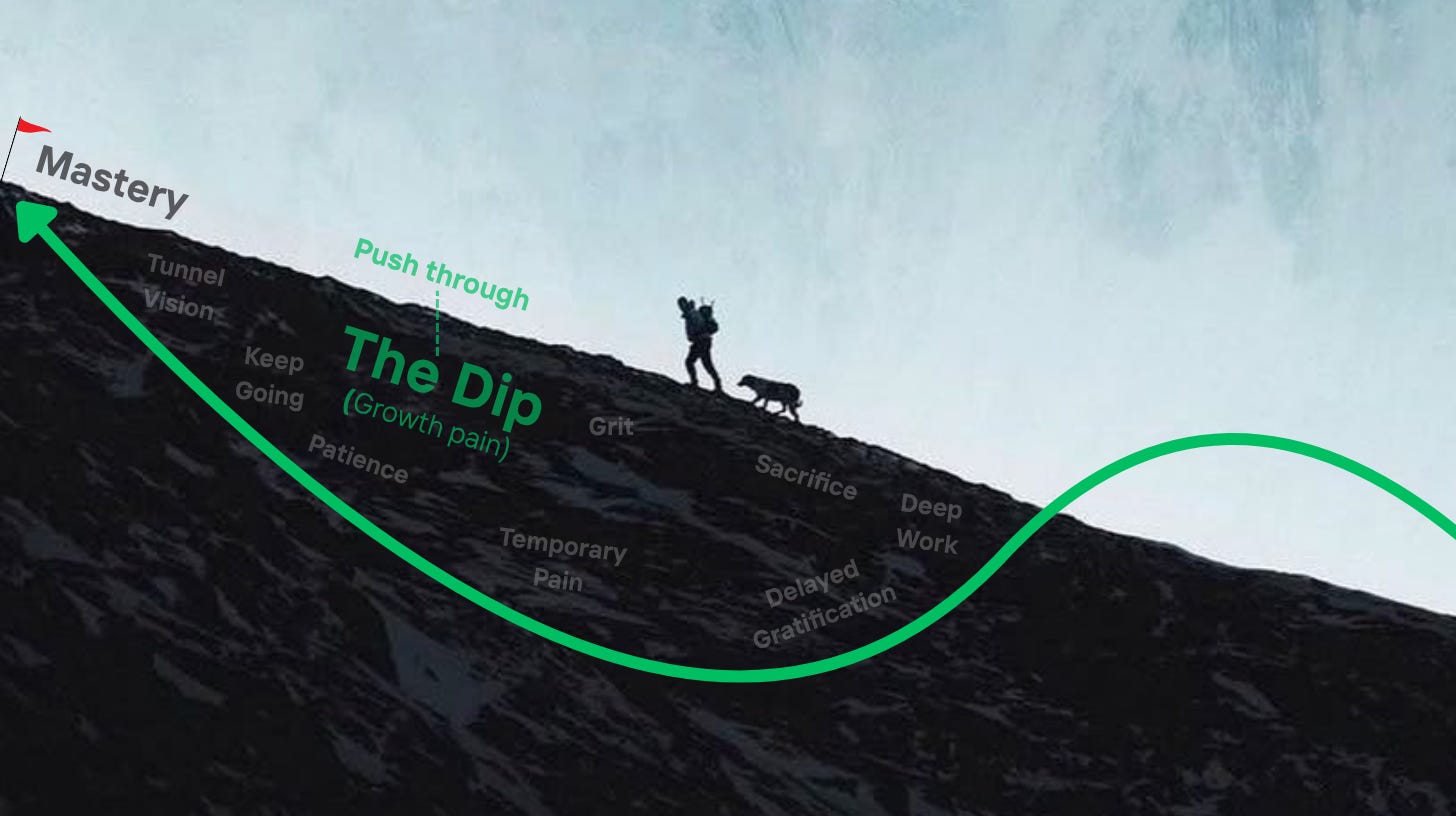
A Dip is temporary pain that leads to mastery.
You make progress. You hit a wall. Doubt creeps in. But if you push through, you get better. The struggle decreases. The payoff increases.
Think about learning an instrument. First few sessions feel good. Then you plateau and it stops feeling like progress. That’s when most people quit, but it’s also when the real learning starts. That’s the Dip.
Signs you’re in a Dip:
Progress is visible, even if slow
Mistakes decrease over time
You feel challenged, not defeated
The struggle has a clear endpoint
Worth it. Stick.
The Cliff
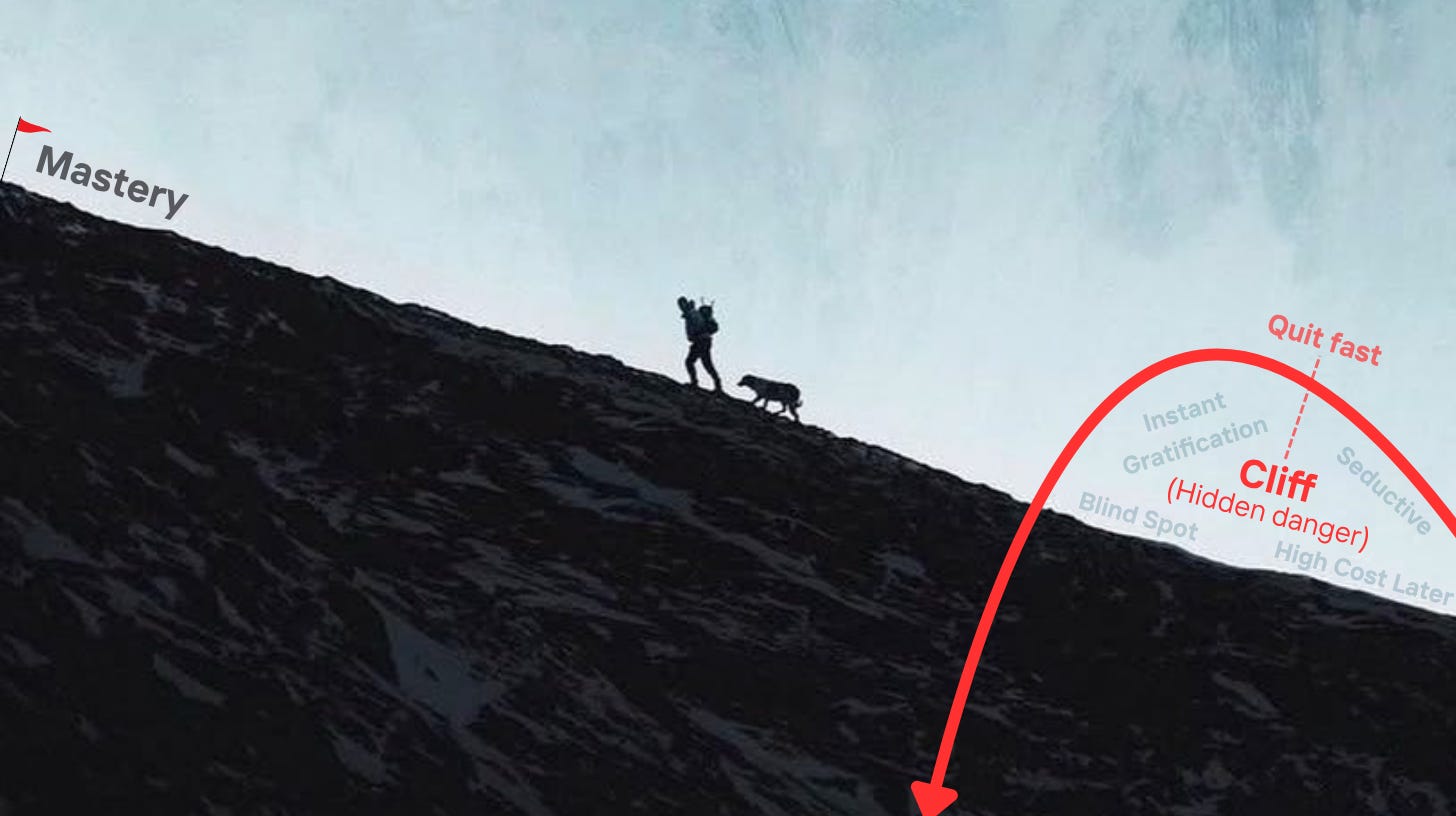
A Cliff starts with excitement. You’re hyped. You wake up early. Dopamine is high.
Then it crashes.
Think of that relationship. Instant spark. They become your whole world in days. Dopamine. Serotonin. Oxytocin. Everything moves so fast you dismiss the red flags. It feels like a dream. Then one day — gone. Like you never existed. You crash.
Cliffs are dangerous because they feel incredible at the start. Then problems pile up. Progress stalls. What seemed promising? A mirage.
Signs you’re on a Cliff:
Initial excitement → rapid despair
Early progress → constant failure
You feel done, not just tired
Get off before you crash.
The Cul-de-Sac
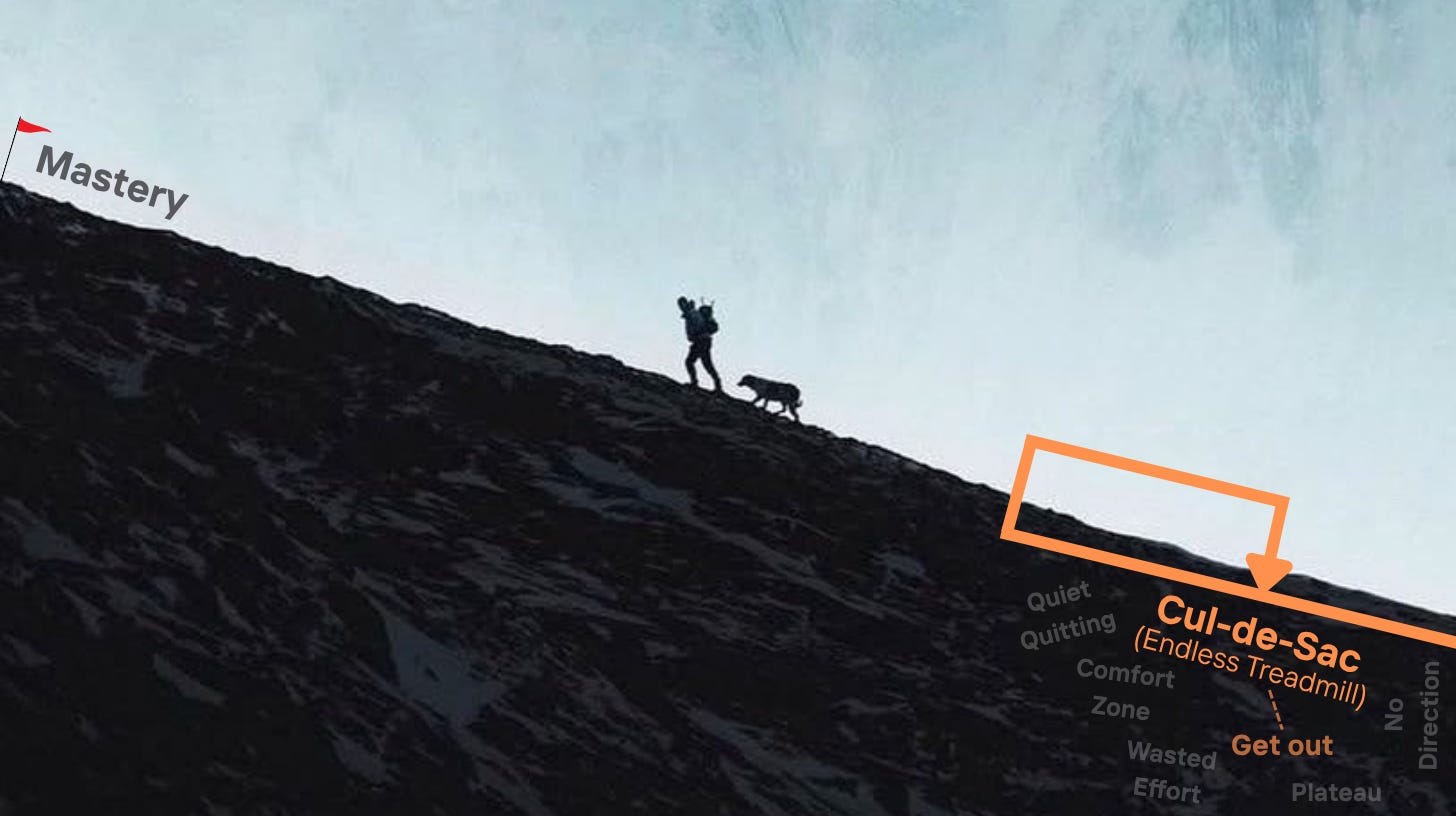
In French, cul-de-sac literally means “bottom of the bag” — a dead-end road that loops back on itself.
You keep moving. You keep trying. But you’re not going anywhere. Just spinning.
Think of that job when you were up for a promotion — for several years. You keep going through the process over and over again, yet every time despite your best effort, you get passed on. You keep trying, yet the results are always the same. No explanation. No feedback.
This type is the easiest to miss because the constant frustration starts to feel like comfort. Like familiarity. Like maybe this is just how hard things feel.
It’s not.
Signs you’re in one:
The same problems repeat every week
You spend more time troubleshooting than building
Your body says stop — burnout that rest doesn’t fix
Flow happens everywhere except here
You dread it before you even start
The hardest to leave. Because leaving feels like quitting. Walk anyway.
To Recap
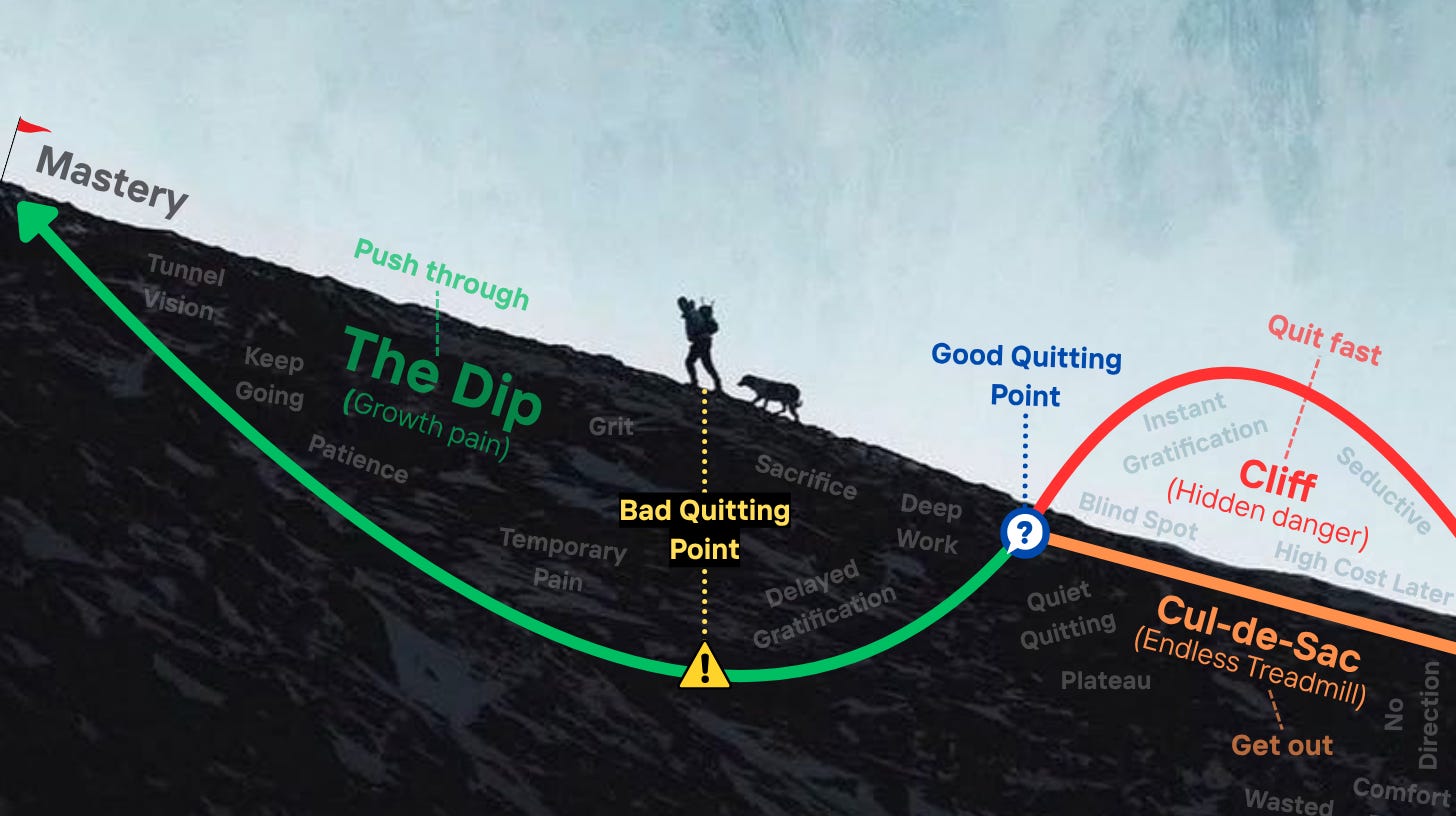
The Dip > Growth Pain > Push Through
The Cliff > Hidden Danger > Quit Fast
The Cul-de-Sac > Endless Treadmill > Get Out
Back to Atom.
The first week felt like a Cliff — the excitement was real, the crash came fast. But I kept going. Week two, week three. Same problems. Same circular troubleshooting. Same explanations to an agent who’d forgotten everything by morning.
That’s not a Cliff anymore. That’s a Cul-de-Sac wearing a Cliff’s clothes.
Knowing the difference matters. One tells you to cut your losses early. The other tells you to stop going in circles.
I was doing both — and calling it persistence.
Why Quitting Gets a Bad Rap
“Winners quit all the time. They quit the right stuff at the right time.” — Seth Godin
We’re taught that quitting is failure.
“Winners never quit. Quitters never win.” “Grit is everything.” “If it’s hard, that means you’re growing.”
But that’s incomplete.
Not all hard things are worth doing. Some lead to mastery. Some lead to crashes. Some lead nowhere.
And the cost of not quitting? Higher than you think.
The sunk cost fallacy says: “I’ve already invested so much. I can’t quit now.”
So you keep going. Even when your body says stop. Even when the problems are circular.
But the time you already spent is gone. You can’t get it back whether you quit or keep going.
The only question left: what do I do with the time I have?
Every hour in the wrong thing is an hour stolen from the right one. I was spending hours every day managing Atom — troubleshooting, correcting, re-explaining. Time I wasn’t writing. Wasn’t building anything that mattered.
Some things give back more than they take. Invest 10, get back 20. That’s leverage.
Atom was the opposite. Put in 100. Get back 10. That’s not a tool. That’s a liability.
Letting Go
I wrote about this in my first article — the only constant is change. The work isn’t resisting it. It’s adapting.
But adaptation demands letting go.
Of tools that stopped working. Identities you’ve outgrown. Whatever version of you needed that old strategy, he’s already gone.
Clinging to what’s broken just prolongs the damage. Letting go is how you actually move.
“If you get on the wrong train, get off at the next stop. The further you travel, the more expensive the return ticket will be” — Japanese Proverb*
Quitting the wrong thing IS letting go. Not giving up on the goal — giving up on the path that’s blocking you from getting there.
The Kill Switch
So how do you know?
Dip or Cul-de-Sac? Push through or walk away?
Set the Kill Switch before you start.
Decide the conditions under which you’ll quit — before you’re emotionally invested. Because once you’re in it, sunk cost takes over. You rationalize. You push through when you shouldn’t.
Set the criteria upfront. Give yourself permission to quit when the conditions are met.
No shame. No second-guessing. Just: “I said I’d quit if X happened. X happened. I’m out.”
My Personal Kill Switch
(Wrote down an extended version of these in my journal 2 years ago. Changed my life)
When growth stops. Not slows — stops.
When the dynamic turns toxic. Manipulation, disrespect, control, gaslighting.
When my body says stop. Consistent pain, burnout, exhaustion that rest doesn’t fix.
When the environment won’t change. You tried. It didn’t shift. Leave.
When investment is one-sided. You give 100, they give 10.
When you start betraying yourself, shrinking to keep the peace, abandoning your own knowing.
When there’s no alignment. Values, vision, direction don’t match. One mistake is human. A pattern is a choice.
These aren’t just job-quitting rules. These are life rules. Use them for relationships, projects, tools — anything you’re considering walking away from.
How to Quit Without Shame
“If you double the number of experiments you do per year you’re going to double your inventiveness.” — Jeff Bezos
Quitting isn’t failure. Quitting is discernment.
It’s saying: this isn’t working, and I’m choosing something better.
You’re not giving up. You’re redirecting. The goal stays. The broken path goes.
I didn’t quit building mūtbl. I quit using an agent that was blocking me from building it.
That’s not failure. That’s discernment.
What I Did
I didn’t rage-quit. I didn’t delete everything in frustration.
I pivoted.
Disabled Atom — honored the meltdown, stopped forcing it
Set a deadline — three weeks to reassess, not forever, just a pause
Explored alternatives — researched what else might work, Claude my alternative
Rested — grocery shopping, meal prep, sleep
Kept shipping — articles, social media, momentum without Atom
Full disclosure: the excitement I felt installing Atom was real. Waking up at 4am, couldn’t wait for morning — classic Cliff. I see it now.
The tool itself is impressive. Still early, still fragile, still deeply technical. Not right for someone non-technical with a bigger mission to build. But don’t sleep on it — just adjust your expectations for now.
The Invitation
What are you holding onto that you should let go?
The job that drains you — even though you’ve been there five years? The relationship that’s over — even though you’ve invested so much? The tool, the strategy, the identity that worked once but doesn’t now?
What’s your Kill Switch?
Write it down. Right now.
“I’ll quit if...”
And then honor it.
Because quitting the wrong thing isn’t failure.
It’s freedom.
You’re not who you were. You’re not yet who you’ll be.
And the way forward isn’t clinging to what’s dead. It’s letting go. So you can create.
Change starts with ū.
What’s on your Kill Switch list? Reply and tell me — I’d love to hear what you’re learning to let go of.